If you’re reading this column on the printed page, you’re a member of a shrinking minority of people who read newspapers today. A generation ago, 70 percent of adults read a newspaper every day. Today, that number is just over 30 percent. Among young people — the under-30 set — the numbers are sharply lower than that.
But this isn’t news. Daily newspaper circulation has been declining for years. The troubles newspapers are facing today, from Main Street to Wall Street, are old news.
Technology has changed everything, turning the newspaper industry (among others) upside down. Fifty years ago, newspapers were your source to find out what was going on around the world or down the road. Today, anything you want to learn about, any piece of information, is just a click or two away, delivered to your desktop or to your mobile device, wherever you are. More than that, you can customize the news and information you want, so that you don’t have to waste your time sorting through information that someone else — an editor — has decided is important.
Daily papers rushed to jump on the information superhighway, putting all their content on their Web sites, without first figuring out how to reap advertising revenues in the new medium. They lost circulation and advertising revenues as a result and their profit margins slipped. Investors in publicly traded newspaper companies started to panic, resulting in the gloom-and-doom headlines we’ve all grown accustomed to reading: sell-offs, layoffs, buyouts, cutbacks.
That’s what prompted one of our loyal readers to ask me, during a Q&A at a recent speaking engagement, whether “his” community newspaper was in trouble, too. Is The Suffolk Times Is the News-Review going to be here 10 years from now? “How else will I find out what’s going on in my community?” he asked.
I was touched both by the man’s concern and by the reminder of the important role newspapers like The Suffolk Times the News-Review play in the community we serve.
We’re not going anywhere. Community journalism is alive and well and community newspapers like ours are, in fact, thriving. That’s because community newspapers provide people with news and information they really can’t get anywhere else — at least not yet. The daily papers have begun to notice this, and the new mantra among newspaper industry executives struggling and experts is now “local, local, local.” One of the most popular buzz words you hear in the industry now is “hyper-local.”
That describes what we do, and what we’ve been doing for 150 years, for 139 years, to a T. And it also describes what we’ll continue to do, and do better than anyone else, in the future.
But how we do it in the future will inevitably change — just as the look and feel of newspapers have changed, with better reproduction, color photographs and more graphics. We’ve adapted, retooled and improved. And we’ll continue to adapt, retool and improve.
The Web will continue to grow in importance as a means by which people access and consume news, including “hyper-local” news. As a result, the way news is packaged and presented will continue to change. News consumption is increasingly becoming a multimedia experience — it’s much more than words on a page, accompanied by a photo or two. Consumers now expect to be able to access photo slideshows, videos, audio interviews and podcasts as part of their online news experience. Even the label we use to describe the people we work for — you — has changed. You’re no longer readers; now you’re consumers and users.
The Web will also play an ever-larger role in news gathering and reporting, too. It has revolutionized the way reporters research their stories and even the way they find sources and leads.
Technology has also increased our ability to spend more time in the communities we cover. We can report, write a story on our laptop, take photos and videos with our digital cameras and file them all by e-mail from anywhere, completing our job without ever stepping foot in the newsroom.
Unless you’re a technophobe or averse to change, this is a really exciting time to be a journalist. The opportunities are nearly endless, and they are as accessible to small community publications like ours as they are to the bigger daily papers — because technology is inexpensive, easy to use and available to everyone.
We are embarking upon a major overhaul of our existing Web sites this year. Our goal is to make them more dynamic, interactive and user-friendly, and provide you with a rich, multimedia experience.
Soon, we’ll be publishing breaking local news on our Web site as it happens every day. You won’t have to wait till Thursday anymore. But you can still look forward to in-depth comprehensive coverage and analysis of the events and issues that matter most to you every Thursday in print.
We’ll have videos and podcasts and the ability to send the news and sports feeds you want to your computer or your Blackberry.
There will be blogs about neighborhoods and topics that hit home, as well as message boards where you can discuss what’s important to you with others who share your concerns.
We’ve got a long way to go, but we’re on our way. And we’d love to hear from you about what functions and features you’d like to see on our Web site. Until we get our message board up and running, we’ll have to communicate the old-fashioned way: Send me an e-mail at denise@timesreview.com. Or comment on my blog at civiletti.blogspot.com. I look forward to hearing from you.
Thursday, March 01, 2007


Saturday, February 17, 2007
Smart growth
I spent this week in Reston, Virginia, attending an American Press Institute seminar called "Leading the 24/7 Newsroom." The hotel where the 50 or so seminar attendees stayed was located in Reston Town Center. While we didn't have a lot of free time to explore (API seminars are pretty intense) I was struck by how Reston Town Center was laid out. It seemed to me to be a very well planned, modern, suburban "downtown." There is a central plaza, with an ice skating rink and fountains, surrounded by a rich mix of residential and commercial uses — the Hyatt Regency (where we stayed), street level retail shops and restaurants, a 13-screen multiplex movie theater, with offices, apartments and condominiums rising above these ground level uses. There's also a multi-level parking garage (but no huge paved parking lot to serve the stores and hotel).
It occurred to me that I was staying in a built-out planned development district that exemplifies what we talk about here on the East End — a very walkable, pedestrian-friendly, well-planned mixed-use suburban "downtown." We talk about this sort of thing an awful lot around here lately. But nobody's even come close to attempting to build such a thing. And whether anyone will ever succeed in doing so (on a smaller scale, with multi-level buildings that are not so tall, of course) remainst to be seen.
Curious about where I'd just spent the past week, I did a little searching on the Web this morning and found some interesting stuff about Reston.
Turns out, Reston was the first post-war planned community in the U.S. It was founded by Robert E. Simon, who bought some 7,000 acres of land outside of Washington, D.C. in the 1960s, between the capital district and a planned airport (now Dulles International). The town is named for Simon; its name is his initials (RES) plus -ton, the English suffix for "town." He was interested in planned communities and had "an aversion to the automobile," so he wanted to establish a community that would be very walkable. Interesting note: He'd lived on Long Island, in a house on a five-acre lot, and felt that the sprawling suburban landscape was isolating for his family.
The Reston Association has a history of the community on its Web site. And I also came across a podcast of an interview with Bob Simon, at age 92, in which he speaks about what motivated him to establish the community and what his goals were. (The podcast interview was done by Planetizen, a planning and development network whose Web site looks pretty interesting, too.)
One key quote from the Simon interview: "Zoning ordinances all over the country made mixed use virtually impossible." Why? Zoning codes establish separate districts for residential, shopping, office and other commercial uses. How true. And the familiar sprawling suburban landscape we live in is the result.
The notion of "mixed use" is relatively new, Simon being a pioneer in the field and Reston being the result. Simon also employed lots of other principles that other communities, like ours, are just starting to implement in pursuit of open space and energy conservation, such as clustered development and zero lot line homes. In addition to housing, retail, commercial and high-tech industrial uses (businesses that employ more than 30,000 people), Reston has 1,300 acres of open space forever preserved, plus miles of walking, jogging and bike trails, parks, 14 community pools, tennis courts, golf courses, and, as mentioned, an ice rink. The residential uses are mixed as well, from typical suburban single-family homes on substantial lots, to high rise and garden apartments, townhouses and condos, with the denser development concentrated around the downtown, much like the "halo" zones currently under consideration for hamlet areas in Southold Town.
I'd be interested to know how these concepts work with re-development plans such as what Riverhead is aiming for with its downtown "master developer" idea, and whether other communities have successfully used them to do what Riverhead is hoping to accomplish downtown. Anybody out there know of such a place or places? Maybe the Planetizen site has more info.
It occurred to me that I was staying in a built-out planned development district that exemplifies what we talk about here on the East End — a very walkable, pedestrian-friendly, well-planned mixed-use suburban "downtown." We talk about this sort of thing an awful lot around here lately. But nobody's even come close to attempting to build such a thing. And whether anyone will ever succeed in doing so (on a smaller scale, with multi-level buildings that are not so tall, of course) remainst to be seen.
Curious about where I'd just spent the past week, I did a little searching on the Web this morning and found some interesting stuff about Reston.
Turns out, Reston was the first post-war planned community in the U.S. It was founded by Robert E. Simon, who bought some 7,000 acres of land outside of Washington, D.C. in the 1960s, between the capital district and a planned airport (now Dulles International). The town is named for Simon; its name is his initials (RES) plus -ton, the English suffix for "town." He was interested in planned communities and had "an aversion to the automobile," so he wanted to establish a community that would be very walkable. Interesting note: He'd lived on Long Island, in a house on a five-acre lot, and felt that the sprawling suburban landscape was isolating for his family.
The Reston Association has a history of the community on its Web site. And I also came across a podcast of an interview with Bob Simon, at age 92, in which he speaks about what motivated him to establish the community and what his goals were. (The podcast interview was done by Planetizen, a planning and development network whose Web site looks pretty interesting, too.)
One key quote from the Simon interview: "Zoning ordinances all over the country made mixed use virtually impossible." Why? Zoning codes establish separate districts for residential, shopping, office and other commercial uses. How true. And the familiar sprawling suburban landscape we live in is the result.
The notion of "mixed use" is relatively new, Simon being a pioneer in the field and Reston being the result. Simon also employed lots of other principles that other communities, like ours, are just starting to implement in pursuit of open space and energy conservation, such as clustered development and zero lot line homes. In addition to housing, retail, commercial and high-tech industrial uses (businesses that employ more than 30,000 people), Reston has 1,300 acres of open space forever preserved, plus miles of walking, jogging and bike trails, parks, 14 community pools, tennis courts, golf courses, and, as mentioned, an ice rink. The residential uses are mixed as well, from typical suburban single-family homes on substantial lots, to high rise and garden apartments, townhouses and condos, with the denser development concentrated around the downtown, much like the "halo" zones currently under consideration for hamlet areas in Southold Town.
I'd be interested to know how these concepts work with re-development plans such as what Riverhead is aiming for with its downtown "master developer" idea, and whether other communities have successfully used them to do what Riverhead is hoping to accomplish downtown. Anybody out there know of such a place or places? Maybe the Planetizen site has more info.
Thursday, February 15, 2007
Asking help for Bryan
Those of us lucky enough not to know what it's like, well, we really have no idea.
We can only imagine, if we can even let our minds wander there. I don't know about you, but I can't do it. The thought of one of my children being stricken by a serious, potentially fatal, illness is too much. When I try to imagine what that might be like, my chest tightens, my body shivers and my mind just won't go there. I guess that what the saying means: I can't wrap my mind around it.
The only reason I've tried to imagine it is, like most of the other lucky parents, I sometimes try to put myself in the shoes of those who've found themselves confronted with a child's illness or even death. The unthinkable. The unspeakable.
"I don't know how you deal with this," I said once to an acquaintance of mine, Mary Lou Tressler. A former owner of Jet Set Printing in Riverhead, our children were in nursery school together.
"I don't have any choice," she answered. "What else can I do?"
Her words stay with me. What else can she do, indeed?
Her son, Bryan, was diagnosed with neuroblastoma, a rare, generally fatal, childhood cancer, when he was just 5 years old. Doctors told his parents, Mary Lou and her husband, Bob, that there was no hope. But Bob and Mary Lou refused to give up. They searched high and low until they found doctors willing to treat Bryan with new, cutting-edge therapies that were then still in development. Thanks to such aggressive treatment — some of it classified as experimental — Bryan has survived. He's now going on 14. But it hasn't been easy, and the future, even after all he's been through, is still bleak.
Bryan is a brave young man. He was brave before he understood the meaning of the word "courage." He's instinctively fought a battle he didn't even know he was engaged in at first — he was too young to understand. Maybe that worked to his advantage. He wasn't mentally or emotionally dragged down by the horrible disease trying to steal his life away because he was too young to understand his affliction. So he lived a kid's life, typical of so many little boys. He played baseball. He went sailing with his dad on the family boat. He scraped his knees, collected bugs, played video games.
Now he's old enough to understand the concept of courage. He's also old enough to understand his illness, old enough to ask "Why?" Old enough to be mad as hell at the unfairness of it all.
But he's still brave. Maybe more so, because now he understands. And he still fights.
A few years back, at the Riverhead Relay for Life, Bryan told the crowd how important it is to fight, to soldier on. "We'll find a cure one day," he said. He was maybe 10 or 11. Everyone marveled at his strength, including me. I wrote a column about it, in fact.
Bryan's battle continues. His cancer has come back with a vengeance, yet again. Bryan is a fighter and endures the physical pain of both the disease and its treatments. His parents and siblings are coping. But the cancer and the treatments are now taking a major financial toll on the family and they are in need of help.
The Tresslers moved upstate a few years back. Bryan's father, Bob, sold his printing business, and the family relocated to a rural area, where there would be less pressure and where Mary Lou and Bob would be able to spend less time working and more time with Bryan and his siblings, Robert and Jennifer.
Bryan now has to make a 180-mile round-trip journey for treatment four to six times each month from his home in Granville, N.Y., to Children's Specialty Center in Burlington, Vt. He also has to travel to Albany five times each week for transfusions, radiation and blood tests.
Mary Lou wrote to me last week asking for help, seeking gas card donations to help them pay for travel to and from treatments. Asking for help certainly wasn't easy for her to do, but it's nothing compared with the reality she has to deal with every day.
I know many people in Riverhead knew Bryan and his family before they moved, and many folks would want to know if they are in need of assistance now. If you can help, with either a check or a gas card, mail it to Friends of Bryan Tressler, P.O. Box 92, Granville, NY 12832.
I would love to organize a fundraiser for Bryan. If you have any ideas for how we might raise some money, or want to help with the effort, please e-mail me at denise@timesreview.com.
Ms. Civiletti invites you to join a discussion of this topic at civiletti.blogspot.com. Her e-mail address is denise@timesreview.com.
Monday, February 12, 2007
When we get it wrong
Nobody said it was going to be easy.
That's true. Nobody said this was an easy job. In fact, it's pretty tough sometimes.
Reporting, writing, editing and publishing a community newspaper — they all present many challenges, each step of the way.
I don't mind people carrying on and calling me names for expressing my opinion in an editorial or in a column on the op-ed page. I expect it. Especially when I write about a subject as sensitive as the war. I've developed thick skin over the years. I can take it.
Sometimes, reporters make mistakes. Hey, we're only human. But when reporters for community newspapers make errors, it affects our neighbors — or people we do business with, or acquaintances, or friends. No matter what, it's tough. Unlike reporters at a huge daily, working out of some distant office, we live and work in the community we write about.
When we err, we print corrections. We print them on the inside front cover, page 2. But they're never enough to satisfy the person who was affected by something we got wrong. I realize that, but there's not much else I can do.
I'm dwelling on this tonight because we made a mistake in this week's police report in the Suffolk Times. The reporter got her "vehicle 1" and "vehicle 2" mixed up as she wrote up the report of an accident involving a school bus on Route 48 last week. We reported that the bus struck the other vehicle. In fact, acccording to the police report, it was the other way around. The other vehicle struck the bus, the report said.
That may make it seem that the driver of the school bus was at fault, and that's how she took it. To say she was unhappy when she showed up at our office Thursday morning would be an understatement along the lines of saying The Beatles were "popular." She tore me a new one, and there was no placating her.
The driver's dispatcher called me, too — at about 8 am Thursday morning. In an email subsequent to our conversation, she said that the people of Southold view The Suffolk Times "as law." That got me thinking even harder about the awesome responsibility we have. We take our responsibility seriously, all the time. There is a certain amount of power in what we do. We know we must never abuse it, or abuse the trust of the people who rely on our papers each week to understand what's going on in their communities.
Everyone at all of our publications works really hard and cares very deeply about what we do and the communities we cover. Accuracy and fairness are our top priorities. But, yes, sometimes we make mistakes. And when we do, it hurts — and we're sorry. This is one of those times.
That's true. Nobody said this was an easy job. In fact, it's pretty tough sometimes.
Reporting, writing, editing and publishing a community newspaper — they all present many challenges, each step of the way.
I don't mind people carrying on and calling me names for expressing my opinion in an editorial or in a column on the op-ed page. I expect it. Especially when I write about a subject as sensitive as the war. I've developed thick skin over the years. I can take it.
Sometimes, reporters make mistakes. Hey, we're only human. But when reporters for community newspapers make errors, it affects our neighbors — or people we do business with, or acquaintances, or friends. No matter what, it's tough. Unlike reporters at a huge daily, working out of some distant office, we live and work in the community we write about.
When we err, we print corrections. We print them on the inside front cover, page 2. But they're never enough to satisfy the person who was affected by something we got wrong. I realize that, but there's not much else I can do.
I'm dwelling on this tonight because we made a mistake in this week's police report in the Suffolk Times. The reporter got her "vehicle 1" and "vehicle 2" mixed up as she wrote up the report of an accident involving a school bus on Route 48 last week. We reported that the bus struck the other vehicle. In fact, acccording to the police report, it was the other way around. The other vehicle struck the bus, the report said.
That may make it seem that the driver of the school bus was at fault, and that's how she took it. To say she was unhappy when she showed up at our office Thursday morning would be an understatement along the lines of saying The Beatles were "popular." She tore me a new one, and there was no placating her.
The driver's dispatcher called me, too — at about 8 am Thursday morning. In an email subsequent to our conversation, she said that the people of Southold view The Suffolk Times "as law." That got me thinking even harder about the awesome responsibility we have. We take our responsibility seriously, all the time. There is a certain amount of power in what we do. We know we must never abuse it, or abuse the trust of the people who rely on our papers each week to understand what's going on in their communities.
Everyone at all of our publications works really hard and cares very deeply about what we do and the communities we cover. Accuracy and fairness are our top priorities. But, yes, sometimes we make mistakes. And when we do, it hurts — and we're sorry. This is one of those times.
Tuesday, February 06, 2007
Negative reactions
Here's a sampling of the negative reactions to my previous post, which was also published as an op-ed column in three of the Times/Review newspapers last week. Some of them are taken from letters to the editor, which will be printed in this week's papers. Others were from notes sent to me directly, some anonymously.
"To suggest this President, or any President would take this country to war for some kind of political or personal gain, to state as fact this President knowingly lied to enter into a war without any certainty is journalist criminality. Document your evidence so we the people can bring it to Congress so they can take action under our laws and constitution. Without such evidence - stop bloviating."
"How can anyone possibly quote (Hanoi) Jane Fonda as a reputable source of anything outside of Hollywood acting? Here is a person who collaborated with the enemy, who should've been charged with treason, perhaps aided in the deaths of American soldiers in Vietnam and I'm suppose to listen to what she has to say about this war?"
"I am truly disgusted by the lack of backbone displayed by all too many Americans as displayed in recent editorials & letters to the editor in the Suffolk Times. Seem like we have plenty of sunshine patriots who don't have the fortitude to withstand someone else picking up a rifle and fighting for them. Must be a rough life sitting on the sidelines sacrificing nothing while giving all that sound Monday morning quarterback advise to those who make tough decisions based on the real world we actually live in."
"Just like Mrs. Civiletti, I find it very difficult to read letters and columns each week that continually slam our president and keep silent. His decscion to go to war was not only based on WMD and a terrorist connection but also because the UN passed many resolutions that were ignored by Saddam and the UN didn't have the backbone to enforce them. Thank God president Bush did. Also the US congress almost unamiously voted for the war. Most of the people of Iraq are glad we are there. Most ot the soldiers who actually are doing the fighting think we are doing good there. As far as hundreds of thousands dead, how many did Saddam kill???"
"What shall we do in Iran?? In the 1930's the world ignored Hitler and millions lost their lives because they refused to deal with him. The president of Iran has stated his intention to wipe out Israel. Should we stand by and let him attain and use nuclear weapons and then try to deal with him or shall we just roll over and submit to Shariah law because his ultimate goal is that all the world be muslim."
"It’s been several years now and my memory is a bit fogged but I don't recall this administration citing evidence to Congress, the United Nations (UN), or to the American people linking Iraq with the attacks of September 11."
"I usually enjoy your column until I saw that you quoted Jane Fonda...I guess you forget howmany american prisoners were tortured because of her. She openly declared she was for North Vietnam. There is a big difference being anti war and being anti american. No one likes war and in one way or another we are all effected. You better check out these groups you are involved with whether they are anti war or anti american."
"Once again you showed either your ignorance or your dishonesty in you latest article in the North Shore Sun. "My daughters soon-to-be-draft-age teens." Last time I checked there was not a draft in this country and only males over the age of 18 are required to register with the Selective Service."
Sunday, January 28, 2007
"I want dumb bombs and a smart president."
J27 march on Washington
One hundred people from the North Fork joined tens of thousands from across the country at a massive anti-war demonstration in Washington, D.C. Saturday. North Fork People of Conscience coordinated the trip to the nation's capital for the march organized by United for Peace and Justice.
Click the image above to see pictures of the protest.
I signed myself and my two teenage daughters up for the trip because I just can't take it any more. The news every day of the bloodshed in Iraq, the chaos in Baghdad, hundreds of thousands of lives lost — to what end? There will be no good resolution of this mess, no "victory." (For how many years — and how many deaths — did the U.S. pursue "victory" in Vietnam?) The pointlessness of our continued occupation of Iraq seems perfectly clear to everyone but the Bush administration. Even Congress is catching on. Saturday's rally was intended to send the message to Congress that it must no longer fund Bush's war. As one speaker put it, you can't be opposed to the war and at the same time vote to fund it. Legislators are in a pickle. What happens if they refuse funding when the "surge" troops are already on the ground? Congressman Tim Bishop told me that by the time Congress votes on the funding, some of those 21,000 "surge" troops will already be over there. It's an ugly choice, but they have to make it.
We boarded two charter buses shortly after 5 a.m. on First Street in Riverhead. Gwen Schroeder and Pat Hovey of NFPOC checked everybody in on our bus, gathering cell phone numbers and providing information about where and when we'd meet up for the return trip home. It's a long ride to D.C. All the kids — I was heartened to see there was a good sized contingent of high school and college kids — slept most of the way down. We arrived at the Greenbelt Metro Station around 11 a.m. There were hundreds of charter buses in the lot and much excitement in the air. The train to the downtown Capital district was jammed.
So were the streets when we got there. And so was the National Mall, the staging area for the demonstration. The entire mall area for the length of three football fields (my rough "eyeball" estimate) was filled with people. Plus there were people scattered all around the periphery. The D.C. police, who have apparently discontinued their practice of giving official estimates of crowds, told the media "privately" that they thought fewer than 100,000 people attended. To borrow the vice president's favorite word, HOGWASH. It's unfortunate that there was no good place from which to take a good shot of the assembled masses. A couple of photographers climbed trees on the sidelines and took photos, but from where they were perched, they could shoot the crowd just in front of the stage. The masses of people jammed into the mall behind them weren't in their photos. The police or the federal government had a helicopter circling overhead the entire day. I bet they got some good crowd shots. And I bet we never get to see them.
I have a suggestion for protest organizers, if they are really interested in documenting attendance at these demonstrations. They should rent a bucket, or cherry-picker, the kind utilities use to access overhead lines. They can put a photographer/videographer up in the bucket just behind the stage and have an excellent vantage point for shooting the crowd — the whole crowd — as it assembles and marches. It's a relatively inexpensive and readily available piece of equipment to rent. And it would provide excellent documentation for refuting the typically ridiculously low official attendance estimates (private or otherwise.)
The sights and sounds at events like this are always pretty interesting. An "Uncle Sam" on stilts. People sporting "Buck Fush" t-shirts. Anarchists against the war. Republicans against the war. Veterans for Peace. Quakers. Socialists. People assembled in groups according to religious beliefs, political affiliations and sexual orientation. People hawking literature ranging advocating beliefs ranging from Christian pacifism to Communism. One guy who stood, simply, for "Free Hugs."
And signs, lots and lots of signs, with so many clever sayings and slogans. My favorite: "I want dumb bombs and a smart president."
My kids were wide-eyed, never having seen anything like this before.
We pushed as far forward toward the stage as we could get. We got to hear speeches by the Rev. Jesse Jackson and Jane Fonda. She said this was her first anti-war protest in 34 years. She has been reluctant to speak out against the war in Iraq, she said, because she was such a lightning rod for controversy during the Vietnam war (I had to explain to my daughters about "Hanoi Jane"). But, she told the crowd, "Silence is no longer an option." Fonda brought her daughter and two grandchildren on stage, noting that her daughter was just a baby at the last anti-war protest she attended.
My daughters had never been to Washington before, and I was determined that they should see both the Lincoln Memorial and the Vietnam War memorial while we were there. Both of those monuments provide rich historical context for what's going on right now in America. So we didn't stay with the march for its entire route. Instead, as marchers slowly made their way toward the Capitol, we bolted and hoofed toward the Lincoln Memorial. We stopped briefly at the Washington Monument and the World War Two Memorial, walked past a drained reflecting pool, and (not without some complaint from my teenagers) climbed the stairs of our temple of American democracy, dedicated to the memory of one of our nation's greatest leaders, Abraham Lincoln. I am always moved to tears inside that space, reflecting on the immortal words of President Lincoln dedicating the battlefield at Gettysburg. Yesterday, the tears flowed more than they ever had before, with the backdrop of the protest, Iraq, the diminishment of our great nation on the world stage thanks to the failed foreign policy of the Bush administration. My kids thought I was nuts. Maybe I am. They read the words of the Gettysburg Address with me. It's familiar to them. I've read it to them and with them many times before. But they didn't share my emotion. They were more interested in how the words were carved in granite. We went to the small museum in the memorial and looked at a set of tools used by an Italian immigrant (the inscriptions were hand-carved by Italian immigrants — I allowed myself a moment of ethnic pride): a wooden mallet, four metal chisels and a pair of calipers. "No machines?" my daughter asked. Nope, all done by hand, painstakingly, perfectly. "Wow."
Yes, the Lincoln Memorial is a definite "wow" on many levels. And so is the Vietnam war memorial, with the nearly endless sea of names inscribed in marble, commemorating the 58,000+ American war dead. It is moving and a chilling reminder of how history really can repeat itself. There are so many parallels to Iraq.
We lingered at the wall, looking at the names inscribed in it, the laminated sheets depicting photos and brief bios of the soldiers "killed 40 years ago this weekend," the flowers and other memorials, including POW/MIA bracelets, placed at the foot of the wall by family, friends and comrades who have not forgotten the dead — men and women who really did die in vain, defending a failed foreign policy, fighting a war fought under false pretenses, sacrificing their lives in a war that could not be won.
One hundred people from the North Fork joined tens of thousands from across the country at a massive anti-war demonstration in Washington, D.C. Saturday. North Fork People of Conscience coordinated the trip to the nation's capital for the march organized by United for Peace and Justice.
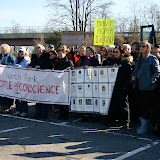
Click the image above to see pictures of the protest.
I signed myself and my two teenage daughters up for the trip because I just can't take it any more. The news every day of the bloodshed in Iraq, the chaos in Baghdad, hundreds of thousands of lives lost — to what end? There will be no good resolution of this mess, no "victory." (For how many years — and how many deaths — did the U.S. pursue "victory" in Vietnam?) The pointlessness of our continued occupation of Iraq seems perfectly clear to everyone but the Bush administration. Even Congress is catching on. Saturday's rally was intended to send the message to Congress that it must no longer fund Bush's war. As one speaker put it, you can't be opposed to the war and at the same time vote to fund it. Legislators are in a pickle. What happens if they refuse funding when the "surge" troops are already on the ground? Congressman Tim Bishop told me that by the time Congress votes on the funding, some of those 21,000 "surge" troops will already be over there. It's an ugly choice, but they have to make it.
We boarded two charter buses shortly after 5 a.m. on First Street in Riverhead. Gwen Schroeder and Pat Hovey of NFPOC checked everybody in on our bus, gathering cell phone numbers and providing information about where and when we'd meet up for the return trip home. It's a long ride to D.C. All the kids — I was heartened to see there was a good sized contingent of high school and college kids — slept most of the way down. We arrived at the Greenbelt Metro Station around 11 a.m. There were hundreds of charter buses in the lot and much excitement in the air. The train to the downtown Capital district was jammed.
So were the streets when we got there. And so was the National Mall, the staging area for the demonstration. The entire mall area for the length of three football fields (my rough "eyeball" estimate) was filled with people. Plus there were people scattered all around the periphery. The D.C. police, who have apparently discontinued their practice of giving official estimates of crowds, told the media "privately" that they thought fewer than 100,000 people attended. To borrow the vice president's favorite word, HOGWASH. It's unfortunate that there was no good place from which to take a good shot of the assembled masses. A couple of photographers climbed trees on the sidelines and took photos, but from where they were perched, they could shoot the crowd just in front of the stage. The masses of people jammed into the mall behind them weren't in their photos. The police or the federal government had a helicopter circling overhead the entire day. I bet they got some good crowd shots. And I bet we never get to see them.
I have a suggestion for protest organizers, if they are really interested in documenting attendance at these demonstrations. They should rent a bucket, or cherry-picker, the kind utilities use to access overhead lines. They can put a photographer/videographer up in the bucket just behind the stage and have an excellent vantage point for shooting the crowd — the whole crowd — as it assembles and marches. It's a relatively inexpensive and readily available piece of equipment to rent. And it would provide excellent documentation for refuting the typically ridiculously low official attendance estimates (private or otherwise.)
The sights and sounds at events like this are always pretty interesting. An "Uncle Sam" on stilts. People sporting "Buck Fush" t-shirts. Anarchists against the war. Republicans against the war. Veterans for Peace. Quakers. Socialists. People assembled in groups according to religious beliefs, political affiliations and sexual orientation. People hawking literature ranging advocating beliefs ranging from Christian pacifism to Communism. One guy who stood, simply, for "Free Hugs."
And signs, lots and lots of signs, with so many clever sayings and slogans. My favorite: "I want dumb bombs and a smart president."
My kids were wide-eyed, never having seen anything like this before.
We pushed as far forward toward the stage as we could get. We got to hear speeches by the Rev. Jesse Jackson and Jane Fonda. She said this was her first anti-war protest in 34 years. She has been reluctant to speak out against the war in Iraq, she said, because she was such a lightning rod for controversy during the Vietnam war (I had to explain to my daughters about "Hanoi Jane"). But, she told the crowd, "Silence is no longer an option." Fonda brought her daughter and two grandchildren on stage, noting that her daughter was just a baby at the last anti-war protest she attended.
My daughters had never been to Washington before, and I was determined that they should see both the Lincoln Memorial and the Vietnam War memorial while we were there. Both of those monuments provide rich historical context for what's going on right now in America. So we didn't stay with the march for its entire route. Instead, as marchers slowly made their way toward the Capitol, we bolted and hoofed toward the Lincoln Memorial. We stopped briefly at the Washington Monument and the World War Two Memorial, walked past a drained reflecting pool, and (not without some complaint from my teenagers) climbed the stairs of our temple of American democracy, dedicated to the memory of one of our nation's greatest leaders, Abraham Lincoln. I am always moved to tears inside that space, reflecting on the immortal words of President Lincoln dedicating the battlefield at Gettysburg. Yesterday, the tears flowed more than they ever had before, with the backdrop of the protest, Iraq, the diminishment of our great nation on the world stage thanks to the failed foreign policy of the Bush administration. My kids thought I was nuts. Maybe I am. They read the words of the Gettysburg Address with me. It's familiar to them. I've read it to them and with them many times before. But they didn't share my emotion. They were more interested in how the words were carved in granite. We went to the small museum in the memorial and looked at a set of tools used by an Italian immigrant (the inscriptions were hand-carved by Italian immigrants — I allowed myself a moment of ethnic pride): a wooden mallet, four metal chisels and a pair of calipers. "No machines?" my daughter asked. Nope, all done by hand, painstakingly, perfectly. "Wow."
Yes, the Lincoln Memorial is a definite "wow" on many levels. And so is the Vietnam war memorial, with the nearly endless sea of names inscribed in marble, commemorating the 58,000+ American war dead. It is moving and a chilling reminder of how history really can repeat itself. There are so many parallels to Iraq.
We lingered at the wall, looking at the names inscribed in it, the laminated sheets depicting photos and brief bios of the soldiers "killed 40 years ago this weekend," the flowers and other memorials, including POW/MIA bracelets, placed at the foot of the wall by family, friends and comrades who have not forgotten the dead — men and women who really did die in vain, defending a failed foreign policy, fighting a war fought under false pretenses, sacrificing their lives in a war that could not be won.
Friday, January 26, 2007
What price silence?
Tomorrow morning before dawn, three busloads of people from the North Fork will depart Riverhead for Washington, D.C. to attend a march for peace. I will be one of them.
The trip from the North Fork is being organized by North Fork People of Conscience. The group has been surprised by the response. Originally planning one bus, they hired a second when the first filled up in just a day. Now they've got three going.
People from every state in the union will be attending the rally and march, whose purpose is to send a message to Congress that American involvement in the war in Iraq must end.
It's been a very long time since I participated in any kind of a demonstration. The last time was, I think, at the U.N., in the early 1980s. I feel foolish to admit that I can't quite remember what it was about. El Salvador, I think. The debacle in the Middle East has inspired me. What a terrible mess. With no easy solutions. Perhaps no solutions at all. It's really very depressing. Hundreds of thousands of lives lost, a country in ruins, America disgraced. Our troops being used as pawns, not only in military warfare in an Iraqi civil war, but in political warfare at home. But, boy, does this sound familiar, as I'm old enough to remember Vietnam. Such a similar scenario. Except this one is actually far more dangerous, because of the powder keg that is the Middle East, and the potential for mass destruction.
Another 20,000 troops? Is that the answer? Not likely. As one of al-Qaeda's top commanders said this week, echoing the arrogant bravado of our own leader a few years back, "bring 'em on." He said we could send the whole army. It wouldn't matter. I think we should heed his warning. There are millions of people there who hate each other, but hate America even more. There is no "winning" this war. Bush, like Nixon decades ago, is casting "victory" as a matter of "honor," characterizing "supporting our troops" as supporting his war, painting people opposition to his war as unpatriotic.
Will this march accomplish anything? Who knows? But I feel compelled to attend, to stand up and join the chorus of Americans in protesting this administration's failed foreign policy and disastrous military initiatives in the Middle East. I can't, in good conscience, remain silent.
The trip from the North Fork is being organized by North Fork People of Conscience. The group has been surprised by the response. Originally planning one bus, they hired a second when the first filled up in just a day. Now they've got three going.
People from every state in the union will be attending the rally and march, whose purpose is to send a message to Congress that American involvement in the war in Iraq must end.
It's been a very long time since I participated in any kind of a demonstration. The last time was, I think, at the U.N., in the early 1980s. I feel foolish to admit that I can't quite remember what it was about. El Salvador, I think. The debacle in the Middle East has inspired me. What a terrible mess. With no easy solutions. Perhaps no solutions at all. It's really very depressing. Hundreds of thousands of lives lost, a country in ruins, America disgraced. Our troops being used as pawns, not only in military warfare in an Iraqi civil war, but in political warfare at home. But, boy, does this sound familiar, as I'm old enough to remember Vietnam. Such a similar scenario. Except this one is actually far more dangerous, because of the powder keg that is the Middle East, and the potential for mass destruction.
Another 20,000 troops? Is that the answer? Not likely. As one of al-Qaeda's top commanders said this week, echoing the arrogant bravado of our own leader a few years back, "bring 'em on." He said we could send the whole army. It wouldn't matter. I think we should heed his warning. There are millions of people there who hate each other, but hate America even more. There is no "winning" this war. Bush, like Nixon decades ago, is casting "victory" as a matter of "honor," characterizing "supporting our troops" as supporting his war, painting people opposition to his war as unpatriotic.
Will this march accomplish anything? Who knows? But I feel compelled to attend, to stand up and join the chorus of Americans in protesting this administration's failed foreign policy and disastrous military initiatives in the Middle East. I can't, in good conscience, remain silent.
Tuesday, January 23, 2007
Looking forward to our day in court
Well, after much fanfare — press releases flying around for more than 10 days — I was finally served with a summons and complaint from Mike Cholowsky late on Friday afternoon.
In the complaint, he says the statement in our story that he pled guilty to a conspiracy to defraud the United States is "completely false. Mr. Cholowsky never pled guilty nor was convicted of any felony involving an attempt to defraud the United States." Well the criminal docket in US. v. Cholowsky shows otherwise. He also labels "completely false" the statement that federal investigators charged Cholowsky's buddy, Joe Provenzano, with using Cholowsky's hauling permit to illegally dump hazardous waste in the Brookhaven landfill. Well, the federal indictment against Joe Provenzano says just that. And Provenzano, by the way, pled guilty to all 17 counts in that indictment. Then the complaint calls "false" the statement that Cholowsky "testified in 1999 that he paid bribes totalling $20,000 to Republican party leader John Powell for the right to dump at the town landfill in Yaphank." Well, the transcript of Cholowsky's testimony in mid-November 1999 at the criminal trial of John Powell says exactly that. And besides, Newsday reported all of these facts (numerous times) in its coverage of the Powell trial in 1999. Did Cholowsky sue Newsday?
Then the complaint accuses us of recklessness, malice and intent to harm, and claims damages of $2 million. It also seeks $10 million in punitive damages.
The complaint is "verified" not by the plaintiff, but by his attorney. Somebody's got to swear to the court that the allegations in the complaint are true, you know.
I can hardly wait to have this matter before a judge, so the plaintiff and his attorney can both explain how they can file a document with the court containing statements which so clearly controvert the public record.
If this isn't an attempt to shut me up, I don't know what is. But it isn't going to work. And our attorneys have been instructed to prepare a counterclaim alleging violation of our right to report this matter, as protected by Article 7 of the New York State Civil Rights Law. We will seek remedies to the fullest extent allowed by law, because this sort of action, known as a "SLAPP" suit, goes to the very heart of the role and function of the press in a free society. And we won't take that lying down.
In the complaint, he says the statement in our story that he pled guilty to a conspiracy to defraud the United States is "completely false. Mr. Cholowsky never pled guilty nor was convicted of any felony involving an attempt to defraud the United States." Well the criminal docket in US. v. Cholowsky shows otherwise. He also labels "completely false" the statement that federal investigators charged Cholowsky's buddy, Joe Provenzano, with using Cholowsky's hauling permit to illegally dump hazardous waste in the Brookhaven landfill. Well, the federal indictment against Joe Provenzano says just that. And Provenzano, by the way, pled guilty to all 17 counts in that indictment. Then the complaint calls "false" the statement that Cholowsky "testified in 1999 that he paid bribes totalling $20,000 to Republican party leader John Powell for the right to dump at the town landfill in Yaphank." Well, the transcript of Cholowsky's testimony in mid-November 1999 at the criminal trial of John Powell says exactly that. And besides, Newsday reported all of these facts (numerous times) in its coverage of the Powell trial in 1999. Did Cholowsky sue Newsday?
Then the complaint accuses us of recklessness, malice and intent to harm, and claims damages of $2 million. It also seeks $10 million in punitive damages.
The complaint is "verified" not by the plaintiff, but by his attorney. Somebody's got to swear to the court that the allegations in the complaint are true, you know.
I can hardly wait to have this matter before a judge, so the plaintiff and his attorney can both explain how they can file a document with the court containing statements which so clearly controvert the public record.
If this isn't an attempt to shut me up, I don't know what is. But it isn't going to work. And our attorneys have been instructed to prepare a counterclaim alleging violation of our right to report this matter, as protected by Article 7 of the New York State Civil Rights Law. We will seek remedies to the fullest extent allowed by law, because this sort of action, known as a "SLAPP" suit, goes to the very heart of the role and function of the press in a free society. And we won't take that lying down.
Thursday, January 18, 2007
A line drawn in the sand
On Jan. 9, the New York City law firm of Sullivan and Gardner issued a press release announcing that Calverton Industries and Michael Cholowsky "have sued" The News-Review and yours truly for libel.
We were made aware of this action not by service of the complaint, nor even by receipt of the press release. I got a phone call from Bruce Tria, the station manager at WRIV, asking for comment on the lawsuit.
On Monday this week, I got a similar call from Lisa Finn, a reporter at the Independent-Traveler Watchman. I told her what I told Tria: I haven't seen the lawsuit so I can't comment on what it says. The Independent published a story this week anyway, under the headline "News-Review, Civiletti sued for libel."
We still haven't been served with any lawsuit. But ever curious — as all good reporters are — I checked the records at the county center yesterday and found that Mr. Cholowsky's attorneys had indeed filed a summons and complaint against Times/Review Newspapers and yours truly on Jan. 9. I guess they just haven't gotten around to serving us.
The complaint alleges that just about everything we reported in our Dec. 14 issue about Mr. Cholowsky's criminal conviction and his role and testimony in the John Powell trial was "completely false." And it alleges that we knew what we published to be false when we "recklessly" published it.
First, we stand by the accuracy of the facts we reported in our coverage. In libel law, truth is an absolute defense to an action. We have truth on our side. If this lawsuit is served, I'm confident that we'll prevail.
Second, we will not be cowed into silence with lawsuits or threats of lawsuits. We've reported on this because it's important and in the public interest. And for no other reason.
The state DEC allowed Cholowsky to dig a 41-acre, 40-foot-deep hole in a special groundwater protection area and fill it up with waste material s. It allowed this without even doing an environmental impact study. It conditioned the mining permit on Cholowsky's staying out of the solid waste industry because of Cholowsky's admitted — on the record, under oath, in open court — payment of bribes to a Brookhaven official and the county Republican leader to gain access to the Brookhaven landfill. Then the DEC turned around and gave the same guy a permit to build and operate a solid waste facility elsewhere.
That's what we reported. And those are facts, in the public record. Just like the plea Mr. Cholowsky entered in federal court — which his lawsuit says never happened. Just like his testimony in federal court that sent John Powell to jail — something else the lawsuit says we fabricated.
But Mr. Cholowsky, in the press release, says we wrote the story "in retribution for my criticism of the most significant policy error facing the Riverhead taxpayer: the $40 million landfill catastrophe." And his attorney, Mr. Sullivan, is quoted in the Independent as saying: "And we are taking further steps to ensure that the avoidance of the $40 million reclamation disaster by issuing untrue statements about our client stops, and the community begins to ask the questions: What happened to the $40 million and where do we go from here?"
Huh?
Obviously Mr. Sullivan hasn't been reading The News-Review. We broke the story of the landfill reclamation mess in this newspaper and have diligently reported on new developments week after week on page 1 over the past year. We even editorialized about the mess many times, asking the very questions Mr. Cholowsky's attorney claims the community should "begin" to ask.
It's nothing short of bizarre that Mr. Cholowsky would link our reporting on his permit issues to the landfill reclamation debacle. We have no stake whatsoever in the town's failed reclamation project, or in its "avoidance." Maybe he's accusing me of carrying water for Barbara Blass, who's been an opponent of the sand mine and a proponent of the landfill reclamation.
The only connection I can see between Calverton Industries and the town's landfill reclamation is sand. And lots of it.
A couple years back, the town was selling its landfill sand cheap to a guy who was making asphalt at the town dump as part of the reclamation project. The asphalt guys were not happy about that. Cheap sand, cheap asphalt. Not a good thing in the mind of the "asphalt cartel" — description courtesy of the U.S. attorney's office. In Nov. 2005, five members of the "asphalt cartel" were indicted in federal court in a bid-rigging scheme aimed at keeping the price of asphalt high, according to federal law enforcement authorities. Among them was a partner in Calverton Industries, John Montecalvo.
Four of the "cartel" boys have since pled guilty under an agreement with the federal prosecutor. No word yet on any plea deal for the remaining "cartel" member, Montecalvo.
There's plenty of speculation about why Montecalvo hasn't taken a plea, and what might be coming next. I'll leave that one to the rumor mill for now. But who was it that once said, "All roads lead to Riverhead?"
Wednesday, January 10, 2007
Res ipsa loquitur
The News-Review was the lead news item on Riverhead radio station WRIV all day today. The newspaper — and its co-publisher Denise Civiletti — "have been sued" by Michael Cholowsky, according to the news report.
But we still haven't seen any lawsuit.
Cholowsky's lawyer yesterday sent out a press release (to WRIV, but not to The News-Review) announcing the lawsuit. In the press release (I got a copy from WRIV when the station called me for comment) he misrepresents what we printed in our coverage last month of the Cholowsky saga and the state DEC — and then says we got it wrong! Clever, ain't it?
I called the lawyer today and asked what's up with the lawsuit I've heard rumors about.
He didn't know. "Um, uh, that's being handled by my associates," he told me today. Punt!
Similarly, on Dec. 20 he admitted he didn't know what was inaccurate in my story when he faxed me a letter that day accusing me of printing inaccurate information and warning me against going to press with a follow-up story and editorial he said he believed I was working on. (I was.) I called him then, too, demanding to know what error I'd made. Absolute accuracy is important to me, and I take care to correct mistakes when I make them, quickly and fully. But he couldn't tell me. When pressed, all he came up with was, "I've only had the file one day." A couple weeks later and he's still short on substance, instead accusing us of printing things we didn't print and then crying foul.
Accuracy, like fairness, is a journalist's stock in trade. Accusing a journalist of being intentionally inaccurate is in itself libelous, and I take it seriously.
So I'm very interested in what this lawsuit is going to say, assuming it gets served. I'm curious to see whether an attorney, an officer of the court, will have the audacity to misstate in court papers what our newspaper printed and then complain that, as miscast, it is libelous.
But Cholowsky's attorney has had a lot of other things on his plate in the last couple of days.
His client was served Tuesday with an appearance ticket, initiating a felony prosecution for filing a false instrument (the Emjay application in which he answered "no" to a question about prior criminal convictions). He's scheduled to be arraigned next month in county district court in Islip.
Cholowsky was also served Tuesday with a revocation notice by the DEC informing him that Calverton Industries' operating permit is revoked, effective immediately.
And he was served at the same time with a notice that the DEC intends to revoke his Emjay operating permit too, because of statements in the Emjay permit application that the DEC now says were false.
So Cholowsky's attorney is one busy dude. The man has a history of keeping lawyers busy though. He's a litigious guy -- Riverhead town has been in almost constant litigation with him for almost a decade now.
Frankly, we fully expected to be on the receiving end of a lawsuit after publishing Cholowsky's permit history in the paper last month. So be it. The thing about libel law is this: TRUTH is an absolute defense.
Check out our story in the Jan. 11 edition of The News-Review at www.riverheadnewsreview.com. We've also posted on our Web site several pertinent documents, including Cholowsky's criminal docket from 2000, his Emjay application "record of compliance," his Calverton Industries permit, and the April 2000 affidavit he gave the DEC swearing he wasn't and wouldn't become involved in the solid waste industry.
As they taught us in law school: res ipsa loquitur. The thing speaks for itself.
But we still haven't seen any lawsuit.
Cholowsky's lawyer yesterday sent out a press release (to WRIV, but not to The News-Review) announcing the lawsuit. In the press release (I got a copy from WRIV when the station called me for comment) he misrepresents what we printed in our coverage last month of the Cholowsky saga and the state DEC — and then says we got it wrong! Clever, ain't it?
I called the lawyer today and asked what's up with the lawsuit I've heard rumors about.
He didn't know. "Um, uh, that's being handled by my associates," he told me today. Punt!
Similarly, on Dec. 20 he admitted he didn't know what was inaccurate in my story when he faxed me a letter that day accusing me of printing inaccurate information and warning me against going to press with a follow-up story and editorial he said he believed I was working on. (I was.) I called him then, too, demanding to know what error I'd made. Absolute accuracy is important to me, and I take care to correct mistakes when I make them, quickly and fully. But he couldn't tell me. When pressed, all he came up with was, "I've only had the file one day." A couple weeks later and he's still short on substance, instead accusing us of printing things we didn't print and then crying foul.
Accuracy, like fairness, is a journalist's stock in trade. Accusing a journalist of being intentionally inaccurate is in itself libelous, and I take it seriously.
So I'm very interested in what this lawsuit is going to say, assuming it gets served. I'm curious to see whether an attorney, an officer of the court, will have the audacity to misstate in court papers what our newspaper printed and then complain that, as miscast, it is libelous.
But Cholowsky's attorney has had a lot of other things on his plate in the last couple of days.
His client was served Tuesday with an appearance ticket, initiating a felony prosecution for filing a false instrument (the Emjay application in which he answered "no" to a question about prior criminal convictions). He's scheduled to be arraigned next month in county district court in Islip.
Cholowsky was also served Tuesday with a revocation notice by the DEC informing him that Calverton Industries' operating permit is revoked, effective immediately.
And he was served at the same time with a notice that the DEC intends to revoke his Emjay operating permit too, because of statements in the Emjay permit application that the DEC now says were false.
So Cholowsky's attorney is one busy dude. The man has a history of keeping lawyers busy though. He's a litigious guy -- Riverhead town has been in almost constant litigation with him for almost a decade now.
Frankly, we fully expected to be on the receiving end of a lawsuit after publishing Cholowsky's permit history in the paper last month. So be it. The thing about libel law is this: TRUTH is an absolute defense.
Check out our story in the Jan. 11 edition of The News-Review at www.riverheadnewsreview.com. We've also posted on our Web site several pertinent documents, including Cholowsky's criminal docket from 2000, his Emjay application "record of compliance," his Calverton Industries permit, and the April 2000 affidavit he gave the DEC swearing he wasn't and wouldn't become involved in the solid waste industry.
As they taught us in law school: res ipsa loquitur. The thing speaks for itself.
Thursday, January 04, 2007
Oh, the things I'll do (before 50)
A ride on the magic carpet
Some things you’d best try to learn when you have youth on your side. Skiing, I’m now convinced, is one of them.
Against my better judgment, I had my first ski experience this weekend. My husband, a veteran skier, was delighted I’d finally given in to his pleas to try it. We rented the necessary equipment and the girls and I signed up for a “level one” (beginner’s) lesson. We were in a group of about eight people. Seven of us were “promoted” at the end of the lesson to “level three.” One of us didn’t make it. Can you guess who that was?
Common sense would have dictated retiring my rented skis, poles and boots after that first session, especially after the instructor broke the news to me that I wouldn’t be joining my kids in “level three” the following day. But no-o-o-o. I’m nothing if not determined. I’d take my “level two” lesson the next morning and, I hoped, reach “level three” in the afternoon.
Little did I know that my humiliation had only just begun.
The “level two” class entailed a ride on “the magic carpet,” a conveyor belt that takes you up a long, gently sloped hillside that serves as a learning trail.
I was scared witless.
“Relax,” the instructor, a saint of a guy named Mike, assured me. “This is a piece of cake. You inch your skis onto the conveyor belt,” he explained. “And then it just takes you.”
I did as instructed, inching my skis onto the belt. And then it took me, all right. I fell backwards in a heap of tangled skis and poles. They had to stop the conveyor belt and haul me up, all before an audience of some 20-odd snickering people, mostly kids. They actually applauded when I was finally righted and set upon the magic carpet once more (this time Mike holding me up so I wouldn’t lose my balance).
Not a quitter, I made several more trips up the “slope” on the magic carpet ride, guided down by Saint Mike, who skied backwards in front of me each time, to prevent me from falling or crashing. I still managed to crash and fall a couple of times anyway.
The whole experience got me thinking. There are so many things I haven’t done yet. And time is running out. I mean, I’ll be 50 this year. My window of opportunity for trying new things is closing — especially if they involve the potential for breaking bones.
The expectations of my youth had me climbing mountains in Tibet, hang-gliding, piloting a plane, writing a book and running for office. OK, I did that last one. But what of the rest of it? Any day now, my AARP welcome kit will arrive in my mailbox, the thought of which sends shivers of panic up and down my spine.
If I’m going to have a mid-life crisis, I may as well do it publicly. And I’d like some help. So here’s a challenge for you, Gentle Reader: What should I do before I turn 50? Send me your suggestions. I’ll try anything within reason. That is, it can’t be illegal, involve marital infidelity or be too expensive; in other words, forget Tibet. Then I’ll write about it. Hopefully not from a hospital bed.
Send me an e-mail: denise@timesreivew.com or post to my blog at civiletti.blogspot.com.
01-04-2007
Wednesday, January 03, 2007
I'm baaaack
Hey, it's been a while and I apologize. We at Times/Review had our annual Christmas holiday week, and I actually forced myself to relax.
Back from our break, things are, of course, nuts here at the newspaper, especially since we came back to a Tuesday, which is crunch day in any week — never mind the week after a week off!
But miracles do happen (they happen every week in fact) and we managed to get the papers done and out to the printer on time.
I don't have any big news to report this week on the Calverton Industries matter. I have had some interesting conversations with people — both in "officialdom" and otherwise — which were, unfortunately, off the record. I expect some things will be happening soon and that this story will certainly be continued. I also expect it to take some pretty interesting turns as the weeks go by.
This week's papers contain our annual "People of the Year" awards. I am always blown away by the amazing people who live and work in our community. It's an honor to be able to recognize them in this way, to show our appreciation for all that they do. It's also always fun to surprise some of these folks like this.
Tomorrow you can read all about exploits on the ski slopes of Vermont. Let's just say for now that I'm not competing in the next Winter Olympics.
Back from our break, things are, of course, nuts here at the newspaper, especially since we came back to a Tuesday, which is crunch day in any week — never mind the week after a week off!
But miracles do happen (they happen every week in fact) and we managed to get the papers done and out to the printer on time.
I don't have any big news to report this week on the Calverton Industries matter. I have had some interesting conversations with people — both in "officialdom" and otherwise — which were, unfortunately, off the record. I expect some things will be happening soon and that this story will certainly be continued. I also expect it to take some pretty interesting turns as the weeks go by.
This week's papers contain our annual "People of the Year" awards. I am always blown away by the amazing people who live and work in our community. It's an honor to be able to recognize them in this way, to show our appreciation for all that they do. It's also always fun to surprise some of these folks like this.
Tomorrow you can read all about exploits on the ski slopes of Vermont. Let's just say for now that I'm not competing in the next Winter Olympics.
Sunday, December 24, 2006
Where's Montecalvo?
It's interesting that Calverton sand mine operator John Montecalvo, co-owner of Calverton Industries, did not participate in the plea negotiations between the U.S. attorney and the other four members of the "asphalt cartel." Their trial on bid-rigging charges was supposed to begin in early January. On Friday, three of the other four defendants pled guilty to conspiracy to commit mail fraud in the bid-rigging scheme, according to a Newsday report. The fourth was supposed to plea, but was ill. Only Montecalvo remains. Will he go to trial or is there some other plea being worked out?
Asphalt, sand, garbage... There's a lot of overlap in terms of who owns the various companies, and some interesting connections to goings-on in the Town of Riverhead.
To be continued...
Asphalt, sand, garbage... There's a lot of overlap in terms of who owns the various companies, and some interesting connections to goings-on in the Town of Riverhead.
To be continued...
Sunday, December 17, 2006
My interview wtih Mike Cholowsky
In reporting the story ("Who's minding the mine?") for last week's News-Review, I called Mike Cholowsky for comment. He called me back late Wednesday, past deadline, and I plan to report on that in the upcoming edition.
He didn't appreciate my questions, to say the least. He accused me of attacking him. Referring to his Brentwood facility, which uses rail to ship garbage (something the DEC really likes because it keeps trucks off the roads, helping to limit air pollution — now that they're forcing LI towns to long-haul thousands of tons of trash off-island!).
"I'm just trying to do a good thing," Cholowsky told me. "Why do you have to put a negative spin on this? Why do you want to attack me?"
He said his mining permit condition (prohibiting involvement in the solid waste industry, as per his affidavit) was intended to apply to the operation of East End Recycling only; it wasn't a general prohibition. I pointed out that the language of his affidavit and the special condition of the permit were both very general and made no mention of East End Recycling.
He said:
"The documents I signed with DEC regarding solid waste pertained to the overlap in East End Recycling's permit at the time. That was going to be a waste facility on Calverton Industries site. As it pertained to that and that site. It was not a general prohibition."
So why was it worded to read like a general prohibition?
"That was, those permits and requirements were, uh, you know, through the DEC. We walked through both applications, both permits."
Cholowsky explained his apparently false answers to DEC application questions this way:
"I just answered the way my lawyer told me to."
I have a copy of the criminal court docket from the U.S. District Court for the Eastern District of New York indicating that Michael Cholowsky III pled guilty to one count of "conspiracy to defraud the United States" in 2000.
Why, I asked Cholowsky, did he answer "no" to the question on the DEC application asking if he'd ever been convicted of a crime involving fraud? (The actual language of the application states "crime involving fraud, bribery, perjury, theft or an offense against public administration."
His answer:
"I pled guilty to conspiracy to make extortion payments. That application was reviewed by my attorney, by DEC attorneys, by everybody involved. I answered them as directed."
What he says he pled guilty to doesn't match the criminal court docket. But even so, how could "conspiracy to make extortion payments" not come within the language on the application?
No answer.
Of course, I also asked him how he knew Barbara Blass had been at the DEC reviewing the Calverton Industries file on the morning of Oct. 2? (As I reported in the News-Review this week, the councilwoman FOILed the CI file, spent the morning of Oct. 2 reviewing it, and got a call from Cholowsky within an hour of her return to Riverhead Town Hall that day, in which he told her she needn't FOIL his DEC records if she wanted to know anything about his business. All she had to do was ask him." Ms. Blass told me she felt the purpose of his call was to intimidate her.
When I asked him this question ("How did you know BB had been at DEC looking at his records...") he laughed for quite a while — too long, it seemed. Then he asked me, "How do you know that I knew?" And then he laughed some more. Then he told me that he really didn't know. I asked, "So what are you, psychic?" More laughter. "No, I wouldn't say I'm psychic." Then the laughter stopped and his voice just got sort of cold, and he said: "But I'm not stupid, either."
OK, then.
He called me back again within 10 minutes to make the following comments (this is how I typed what he said as he spoke, cut and pasted from my notes):
"im a little upset
my emjay project is something that im really proud of
a good concept
i got shot down in calverton
found another location
i really went out on a limb
spent a lot of money
it's unchartered territory
the trouble that i got into in 99
that was the most difficult time of my life
the worst 2 yrs of my life
im not trying to do anything wrong
im trying to do good things
i feel like anything i try to do i get attacked
i think i did a good thing
a good service
if we're going to move a million yards of waste off LI
it should be by rail
i think im doing a good thing
im not trying to hurt anybody
i don't see why i have to be dragged thru the mud & beat up
i made a mistake
i paid dearly for it
i feel like i should have a right to move on"
He didn't appreciate my questions, to say the least. He accused me of attacking him. Referring to his Brentwood facility, which uses rail to ship garbage (something the DEC really likes because it keeps trucks off the roads, helping to limit air pollution — now that they're forcing LI towns to long-haul thousands of tons of trash off-island!).
"I'm just trying to do a good thing," Cholowsky told me. "Why do you have to put a negative spin on this? Why do you want to attack me?"
He said his mining permit condition (prohibiting involvement in the solid waste industry, as per his affidavit) was intended to apply to the operation of East End Recycling only; it wasn't a general prohibition. I pointed out that the language of his affidavit and the special condition of the permit were both very general and made no mention of East End Recycling.
He said:
"The documents I signed with DEC regarding solid waste pertained to the overlap in East End Recycling's permit at the time. That was going to be a waste facility on Calverton Industries site. As it pertained to that and that site. It was not a general prohibition."
So why was it worded to read like a general prohibition?
"That was, those permits and requirements were, uh, you know, through the DEC. We walked through both applications, both permits."
Cholowsky explained his apparently false answers to DEC application questions this way:
"I just answered the way my lawyer told me to."
I have a copy of the criminal court docket from the U.S. District Court for the Eastern District of New York indicating that Michael Cholowsky III pled guilty to one count of "conspiracy to defraud the United States" in 2000.
Why, I asked Cholowsky, did he answer "no" to the question on the DEC application asking if he'd ever been convicted of a crime involving fraud? (The actual language of the application states "crime involving fraud, bribery, perjury, theft or an offense against public administration."
His answer:
"I pled guilty to conspiracy to make extortion payments. That application was reviewed by my attorney, by DEC attorneys, by everybody involved. I answered them as directed."
What he says he pled guilty to doesn't match the criminal court docket. But even so, how could "conspiracy to make extortion payments" not come within the language on the application?
No answer.
Of course, I also asked him how he knew Barbara Blass had been at the DEC reviewing the Calverton Industries file on the morning of Oct. 2? (As I reported in the News-Review this week, the councilwoman FOILed the CI file, spent the morning of Oct. 2 reviewing it, and got a call from Cholowsky within an hour of her return to Riverhead Town Hall that day, in which he told her she needn't FOIL his DEC records if she wanted to know anything about his business. All she had to do was ask him." Ms. Blass told me she felt the purpose of his call was to intimidate her.
When I asked him this question ("How did you know BB had been at DEC looking at his records...") he laughed for quite a while — too long, it seemed. Then he asked me, "How do you know that I knew?" And then he laughed some more. Then he told me that he really didn't know. I asked, "So what are you, psychic?" More laughter. "No, I wouldn't say I'm psychic." Then the laughter stopped and his voice just got sort of cold, and he said: "But I'm not stupid, either."
OK, then.
He called me back again within 10 minutes to make the following comments (this is how I typed what he said as he spoke, cut and pasted from my notes):
"im a little upset
my emjay project is something that im really proud of
a good concept
i got shot down in calverton
found another location
i really went out on a limb
spent a lot of money
it's unchartered territory
the trouble that i got into in 99
that was the most difficult time of my life
the worst 2 yrs of my life
im not trying to do anything wrong
im trying to do good things
i feel like anything i try to do i get attacked
i think i did a good thing
a good service
if we're going to move a million yards of waste off LI
it should be by rail
i think im doing a good thing
im not trying to hurt anybody
i don't see why i have to be dragged thru the mud & beat up
i made a mistake
i paid dearly for it
i feel like i should have a right to move on"
Thursday, December 14, 2006
Sink, stank, stunk again
Incompetence or corruption? That's the question on my mind as I ponder the DEC's record of regulating sand mines in Riverhead.
And considering the cast of characters involved, I'd probably be smart to shut up and forget about it. But I can't.
We've got a sand mine problem in the Town of Riverhead, and the state DEC is right smack in the middle of it.
Beginning in 1998, Calverton Industries excavated 2.25 million cubic yards of sand out of a 41-acre site in Calverton. The company didn't bother to get the required permits from the town or the state before starting its lucrative dig — the estimated market value of the sand hauled out of there was more than $10 million. After the state DEC went to court and got a restraining order, Calverton Industries applied for a state mining permit. Meanwhile, Riverhead adopted a law banning all sand mining here.
Nevertheless, the state DEC gave Calverton Industries a mining permit. And it did so with the minimum amount of environmental scrutiny allowed by law: The DEC issued a negative declaration of significance, a finding under SEQRA that the project would have no significant potential environmental impacts and did not require an environmental impact statement.
A 41-acre hole in the ground, 40 feet deep, located in a state-designated groundwater protection district — a hole that's to be filled with waste as part of the "reclamation" process. No significant potential environmental impacts? Are they kidding?
The negative SEQRA declaration prompted the town to sue the DEC in 1999, a lawsuit the town eventually won in late 2001, when a court ordered the DEC to reconsider its finding.
But the court actions continued and so did the mining — and filling. The mining is completed now and only the filling remains. And the filling of that huge hole is what makes this story really interesting.
While, in the name of groundwater protection, the DEC ordered closed all municipal solid waste landfills on Long Island in the 1990s, the DEC issued permits for several privately run landfills like the one operated by Calverton Industries. The DEC hates it when you call them landfills; they prefer the term "mine reclamation." But they are, in fact, landfills — big holes in which waste is buried.
The type of waste is what makes the difference. Municipal solid waste, or MSW, poses a potential groundwater threat. It contains stuff that would pollute the groundwater if carried to the aquifer by rainwater percolating through the layers of soil. Other types of waste, such as concrete and asphalt made with approved raw materials, are deemed "clean fill" by the DEC, and can be buried in an unlined hole like the one Calverton Industries dug.
But make no mistake: There's plenty of incentive to bury more than clean fill in a hole like the one in Calverton. Disposing of MSW is costly — it either has to be shipped to out-of-state landfills or burned at the Hempstead incinerator; either way the waste hauler must pay significant per-ton tipping fees. If the waste is contaminated — if, say, it contains asbestos or other materials deemed hazardous — the cost of disposal increases exponentially.
Given all that, monitoring what goes into our 41-acre hole in a special groundwater protection district on the edge of the central pine barrens is pretty important, don't you think?
But day-to-day monitoring of the site is on the honor system, because a DEC inspector visits the site only once or twice a week and the town hasn't been allowed access to the site.
Now all this would be unsettling enough if it weren't for the identity of the operators of the site.
Enter Michael Cholowsky, Calverton Industries president. He testified in federal court that he bribed Brookhaven town officials to gain access to the town landfill, where he dumped solid waste in the mid to late 1990s. Cholowsky had a close relationship with East Patchogue salvage yard owner Joseph Provenzano, who pled guilty in 1999 to 17 counts of federal stolen truck, extortion, witness tampering and racketeering charges and was sentenced to eight years in jail. Evidence gathered by federal investigators established that Provenzano was using Cholowsky's hauling permit (issued to his company Sky Materials) to illegally dump hazardous waste at the Brookhaven landfill, according to reports in Newsday in 1999. Cholowsky's testimony helped send John Powell, Suffolk County Republican leader, to prison.
Cholowsky doesn't own Calverton Industries, according to an affidavit he gave the DEC in 2000. He said the company is owned by his brother, Robert Cholowsky, and John Montecalvo, a paving contractor indicted earlier this year on federal bid-rigging charges.
In the affidavit, Cholowsky swore he had no involvement in the solid waste industry and would have no involvement in it, except for handling concrete and asphalt for recycling. The DEC got the affidavit from Cholowsky to safeguard — on paper, anyway — against the dumping of solid waste at the Calverton Industries mine site. The DEC even made the affidavit a condition of the Calverton Industries permit, stipulating that the CI permit would be "deemed" automatically revoked if Cholowsky got back in the solid waste business.
But then the DEC ignored its own permit condition.
In applying for a permit to build and operate a solid waste facility in Brentwood, Cholowsky supplied the DEC in 2004 with signed contracts (signed by him!) indicating that he is in the business of hauling and disposing solid waste. The DEC then issued Cholowsky's company a permit to process 200 tons per day of municipal solid waste.
Evidently the DEC doesn't pay careful attention to the contents of its files. The application forms Cholowsky signed in 2003 and 2004 represented "under penalties of perjury" that he had never been convicted of a crime involving fraud. He pled guilty to conspiring to defraud the U.S. on tax evasion charges in 2000.
The DEC — at the highest levels — does seem to pay attention to who's accessing its files under the freedom of information laws, however. When Riverhead Councilwoman Barbara Blass foiled documents from the Calverton Industries file, DEC regional director Peter Scully reviewed them first, and even attached Post-It Notes to some documents asking questions about their contents before they were turned over to the councilwoman. A couple of those notes were left in the file and copied by Ms. Blass, who showed them to me. I was left wondering what might have been removed from the file before she was given access.
Interestingly, about an hour after the councilwoman returned to Riverhead Town Hall following her appointment at the DEC to review the FOIL documents, Cholowsky called her to tell her that if she had any questions about his business, all she had to do was call him and ask — she didn't need to FOIL records at the DEC. How did he know where Ms. Blass had spent her morning that day?
That's just one of many, many unanswered questions in this saga. Some others: Why are Ed Tuccio and his wife helping to bankroll Mike Cholowsky's financial assurance required by the DEC (to the tune of $200,000)? Cholowsky is a frequent visitor to Ed's bar on Main Street, Tweed's. So is his assistant, Jill Lewis, who left her job as Riverhead deputy supervisor one day and was back in Town Hall the next working for Mike Cholowsky's Sky Materials. So is Lewis's former boss, Richard Amper, executive director of the Long Island Pine Barrens Society — which has had oddly little to say about the Calverton Industries sand mine over the years, in spite of its location at the edge of the pine barrens core preservation area. So is Anthony Coates, who rents an apartment from Mr. Tuccio above the Main Street bar and who was a partner of Cholowsky's in Peconic Golf Partners, which proposed digging a 60-acre "lake" at EPCAL a few years ago. Coates was also very involved in running a campaign for supervisor last year by Cholowsky's partner in a fuel oil business, Councilman Ed Densieski.
When Ms. Blass objected to "settling" the Calverton Industries case after the town had won its court decisions, and demanded that the settlement agreement grant the town access to inspect the site — to monitor what was being buried in the town's special groundwater protection area — Councilman Densieski lashed out at her. "I have three words for this resolution," he said at the April 16, 2002, Town Board meeting. "Stinks, stank and stunk."
Well, Ed, you can say that again. Something sure smells in this whole deal, and it's more than the load of dead fish dumped in Barbara Blass's driveway on April 18, 2002, the morning that page one of The News-Review carried the "Stinks, stank, stunk" headline over a story about Ms. Blass demanding accountability at the Calverton Industries sand mine.
And considering the cast of characters involved, I'd probably be smart to shut up and forget about it. But I can't.
We've got a sand mine problem in the Town of Riverhead, and the state DEC is right smack in the middle of it.
Beginning in 1998, Calverton Industries excavated 2.25 million cubic yards of sand out of a 41-acre site in Calverton. The company didn't bother to get the required permits from the town or the state before starting its lucrative dig — the estimated market value of the sand hauled out of there was more than $10 million. After the state DEC went to court and got a restraining order, Calverton Industries applied for a state mining permit. Meanwhile, Riverhead adopted a law banning all sand mining here.
Nevertheless, the state DEC gave Calverton Industries a mining permit. And it did so with the minimum amount of environmental scrutiny allowed by law: The DEC issued a negative declaration of significance, a finding under SEQRA that the project would have no significant potential environmental impacts and did not require an environmental impact statement.
A 41-acre hole in the ground, 40 feet deep, located in a state-designated groundwater protection district — a hole that's to be filled with waste as part of the "reclamation" process. No significant potential environmental impacts? Are they kidding?
The negative SEQRA declaration prompted the town to sue the DEC in 1999, a lawsuit the town eventually won in late 2001, when a court ordered the DEC to reconsider its finding.
But the court actions continued and so did the mining — and filling. The mining is completed now and only the filling remains. And the filling of that huge hole is what makes this story really interesting.
While, in the name of groundwater protection, the DEC ordered closed all municipal solid waste landfills on Long Island in the 1990s, the DEC issued permits for several privately run landfills like the one operated by Calverton Industries. The DEC hates it when you call them landfills; they prefer the term "mine reclamation." But they are, in fact, landfills — big holes in which waste is buried.
The type of waste is what makes the difference. Municipal solid waste, or MSW, poses a potential groundwater threat. It contains stuff that would pollute the groundwater if carried to the aquifer by rainwater percolating through the layers of soil. Other types of waste, such as concrete and asphalt made with approved raw materials, are deemed "clean fill" by the DEC, and can be buried in an unlined hole like the one Calverton Industries dug.
But make no mistake: There's plenty of incentive to bury more than clean fill in a hole like the one in Calverton. Disposing of MSW is costly — it either has to be shipped to out-of-state landfills or burned at the Hempstead incinerator; either way the waste hauler must pay significant per-ton tipping fees. If the waste is contaminated — if, say, it contains asbestos or other materials deemed hazardous — the cost of disposal increases exponentially.
Given all that, monitoring what goes into our 41-acre hole in a special groundwater protection district on the edge of the central pine barrens is pretty important, don't you think?
But day-to-day monitoring of the site is on the honor system, because a DEC inspector visits the site only once or twice a week and the town hasn't been allowed access to the site.
Now all this would be unsettling enough if it weren't for the identity of the operators of the site.
Enter Michael Cholowsky, Calverton Industries president. He testified in federal court that he bribed Brookhaven town officials to gain access to the town landfill, where he dumped solid waste in the mid to late 1990s. Cholowsky had a close relationship with East Patchogue salvage yard owner Joseph Provenzano, who pled guilty in 1999 to 17 counts of federal stolen truck, extortion, witness tampering and racketeering charges and was sentenced to eight years in jail. Evidence gathered by federal investigators established that Provenzano was using Cholowsky's hauling permit (issued to his company Sky Materials) to illegally dump hazardous waste at the Brookhaven landfill, according to reports in Newsday in 1999. Cholowsky's testimony helped send John Powell, Suffolk County Republican leader, to prison.
Cholowsky doesn't own Calverton Industries, according to an affidavit he gave the DEC in 2000. He said the company is owned by his brother, Robert Cholowsky, and John Montecalvo, a paving contractor indicted earlier this year on federal bid-rigging charges.
In the affidavit, Cholowsky swore he had no involvement in the solid waste industry and would have no involvement in it, except for handling concrete and asphalt for recycling. The DEC got the affidavit from Cholowsky to safeguard — on paper, anyway — against the dumping of solid waste at the Calverton Industries mine site. The DEC even made the affidavit a condition of the Calverton Industries permit, stipulating that the CI permit would be "deemed" automatically revoked if Cholowsky got back in the solid waste business.
But then the DEC ignored its own permit condition.
In applying for a permit to build and operate a solid waste facility in Brentwood, Cholowsky supplied the DEC in 2004 with signed contracts (signed by him!) indicating that he is in the business of hauling and disposing solid waste. The DEC then issued Cholowsky's company a permit to process 200 tons per day of municipal solid waste.
Evidently the DEC doesn't pay careful attention to the contents of its files. The application forms Cholowsky signed in 2003 and 2004 represented "under penalties of perjury" that he had never been convicted of a crime involving fraud. He pled guilty to conspiring to defraud the U.S. on tax evasion charges in 2000.
The DEC — at the highest levels — does seem to pay attention to who's accessing its files under the freedom of information laws, however. When Riverhead Councilwoman Barbara Blass foiled documents from the Calverton Industries file, DEC regional director Peter Scully reviewed them first, and even attached Post-It Notes to some documents asking questions about their contents before they were turned over to the councilwoman. A couple of those notes were left in the file and copied by Ms. Blass, who showed them to me. I was left wondering what might have been removed from the file before she was given access.
Interestingly, about an hour after the councilwoman returned to Riverhead Town Hall following her appointment at the DEC to review the FOIL documents, Cholowsky called her to tell her that if she had any questions about his business, all she had to do was call him and ask — she didn't need to FOIL records at the DEC. How did he know where Ms. Blass had spent her morning that day?
That's just one of many, many unanswered questions in this saga. Some others: Why are Ed Tuccio and his wife helping to bankroll Mike Cholowsky's financial assurance required by the DEC (to the tune of $200,000)? Cholowsky is a frequent visitor to Ed's bar on Main Street, Tweed's. So is his assistant, Jill Lewis, who left her job as Riverhead deputy supervisor one day and was back in Town Hall the next working for Mike Cholowsky's Sky Materials. So is Lewis's former boss, Richard Amper, executive director of the Long Island Pine Barrens Society — which has had oddly little to say about the Calverton Industries sand mine over the years, in spite of its location at the edge of the pine barrens core preservation area. So is Anthony Coates, who rents an apartment from Mr. Tuccio above the Main Street bar and who was a partner of Cholowsky's in Peconic Golf Partners, which proposed digging a 60-acre "lake" at EPCAL a few years ago. Coates was also very involved in running a campaign for supervisor last year by Cholowsky's partner in a fuel oil business, Councilman Ed Densieski.
When Ms. Blass objected to "settling" the Calverton Industries case after the town had won its court decisions, and demanded that the settlement agreement grant the town access to inspect the site — to monitor what was being buried in the town's special groundwater protection area — Councilman Densieski lashed out at her. "I have three words for this resolution," he said at the April 16, 2002, Town Board meeting. "Stinks, stank and stunk."
Well, Ed, you can say that again. Something sure smells in this whole deal, and it's more than the load of dead fish dumped in Barbara Blass's driveway on April 18, 2002, the morning that page one of The News-Review carried the "Stinks, stank, stunk" headline over a story about Ms. Blass demanding accountability at the Calverton Industries sand mine.
Tuesday, December 05, 2006
Caveat emptor
Both my grandmothers were opposed to restaurants — eating at them, that is. For one thing, no restaurant chef could whip up food that truly tasted homemade, they used to say. For another, when you eat out you just never know what you're getting. More specifically, you never know who's handling and preparing your food, and whether they're, well, clean.
I could literally count the number of times I saw either of my grandmothers eat out. Special occasions, usually, and then they'd pick at their food, a look of consternation on their faces. Never, ever, would they eat at a fast food joint!
Needless to say, I don't have the same attitude about eating out. Sometimes eating out or getting takeout is my salvation. And though I'm not a fast food fan myself, my kids would live on Wendy's and pizza — and Taco Bell — if I allowed it.
But Nana was right. When you eat out, you just don't know what you're getting. The current E. coli outbreak at the Taco Bell chain is a good example. Nana cooked for herself and made just about everything from scratch. There's no hope of doing that in the context of my lifestyle. Though I have been known to make my own tacos.
I could literally count the number of times I saw either of my grandmothers eat out. Special occasions, usually, and then they'd pick at their food, a look of consternation on their faces. Never, ever, would they eat at a fast food joint!
Needless to say, I don't have the same attitude about eating out. Sometimes eating out or getting takeout is my salvation. And though I'm not a fast food fan myself, my kids would live on Wendy's and pizza — and Taco Bell — if I allowed it.
But Nana was right. When you eat out, you just don't know what you're getting. The current E. coli outbreak at the Taco Bell chain is a good example. Nana cooked for herself and made just about everything from scratch. There's no hope of doing that in the context of my lifestyle. Though I have been known to make my own tacos.
Tuesday, November 28, 2006
The future of our community hospitals
Significant changes may be in the offing for health care delivery systems on the East End. The much-anticipated report of the Berger commission was released today and it recommends a structural consolidation of the three East End hospitals, with the possible subsequent addition of Brookhaven Memorial. The commission says the hospitals should have one governing board empowered to develop and implement a strategic plan for all facilities. If the hospitals balk, the state health department will not approve any future "certificate of need" applications, which effectively puts them out of business. So they really have little choice but to comply.
This could be interesting in terms of future management of the hospitals. Would they have one CEO instead of three? Will it be one of the CEOs currently running the three independent facillities? Nobody at the hastily convened press conference at Peconic Bay Medical Center wanted to discuss those specifics, so we won't know for a while how this will play itself out.
One CEO said the cost of implementing the commission's recommendations could run to $25 million. Who will foot that bill? The hospitals are certainly in no position to bear that burden. Is this another unfunded mandate from state government? (Like dozens of
To their credit, and to the credit of State Senator Ken LaValle, the East End hospitals are already well on their way to doing a lot of what the Berger commission is recommending, in terms of structural consolidation and affiliation with University Hospital in Stony Brook — the county's ONLY tertiary care hospital.
When you think about it, it's absurd that Suffolk County — which is how many times bigger than Nassau geographically and which has a population that's now bigger than Nassau's — has only one tertiary care center. One for the whole county! Nassau has several such facilities. (North Shore, LIJ, Winthrop, St. Francis, maybe NCMC too.) Wouldn't it make sense for there to be such a center for the eastern part of the county, including the twin forks and eastern Brookhaven? Geographically, Peconic Bay Medical Center is the right place for it. But as far as I can see upon a cursory reading of the commission's 240-page final report, there's no mention of establishing a tertiary care center in eastern Suffolk. That's too bad.
This could be interesting in terms of future management of the hospitals. Would they have one CEO instead of three? Will it be one of the CEOs currently running the three independent facillities? Nobody at the hastily convened press conference at Peconic Bay Medical Center wanted to discuss those specifics, so we won't know for a while how this will play itself out.
One CEO said the cost of implementing the commission's recommendations could run to $25 million. Who will foot that bill? The hospitals are certainly in no position to bear that burden. Is this another unfunded mandate from state government? (Like dozens of
To their credit, and to the credit of State Senator Ken LaValle, the East End hospitals are already well on their way to doing a lot of what the Berger commission is recommending, in terms of structural consolidation and affiliation with University Hospital in Stony Brook — the county's ONLY tertiary care hospital.
When you think about it, it's absurd that Suffolk County — which is how many times bigger than Nassau geographically and which has a population that's now bigger than Nassau's — has only one tertiary care center. One for the whole county! Nassau has several such facilities. (North Shore, LIJ, Winthrop, St. Francis, maybe NCMC too.) Wouldn't it make sense for there to be such a center for the eastern part of the county, including the twin forks and eastern Brookhaven? Geographically, Peconic Bay Medical Center is the right place for it. But as far as I can see upon a cursory reading of the commission's 240-page final report, there's no mention of establishing a tertiary care center in eastern Suffolk. That's too bad.
Friday, November 24, 2006
Black Friday
I was never much of a shopper. My favorite stores are bookstores, hardware stores and stationery stores, in that order.
I'm not a sale-chaser or coupon clipper. And I'm certainly not one to get up and line up in front of a store in the predawn hours, waiting for the store to open, because of some spectacular sale. I'll do it for my kids — to get that Wii, for instance. But to score some hot deal? Nah.
One of my relatives told me yesterday that she and her sister were planning to be at some store (I forget which) this morning at 5 a.m. She loves Black Friday. Not so much for the sales, but for, as she put it, "the thrill of the shop." I can't relate. I dread shopping, unless it involves browsing around a bookstore, a hardware store or a stationery store.
This morning, I glanced at some newspaper inserts as I sipped my first cup of coffee. I noticed Best Buy has a big sale going on. A 32-inch LCD HDTV for $479. Hmm. We're in the market for a TV, so I decided to stop at Best Buy on my way to the gym. It was a casual, spur-of-the-moment decision. At 5 a.m., how many people would be at Best Buy in Riverhead? I'd breeze in and out and go work out.
I am so naive. You'd think after my Wii experience last weekend I'd know better.
At 5:30, a half hour after Best Buy opened, there was a line of people, 3 and 4 abreast, waiting to get IN to the store! The parking lot was jammed. The line went all the way around the corner of the building, past where the people had been camping out in the hopes of scoring a PlayStation 3 or a Wii last week! And it was still dark out! Amazing!
I went directly to the gym. As I pulled into the parking lot, I was shocked to see a line of people waiting for Staples to open at 6! Holy cow!
I went into the gym, feeling like an alien creature. (And grateful for it.) I climbed aboard the Cross-Ramp and ran my butt off for 30 minutes. On the way home, dawn had broken. Every parking lot on Route 58 was jam-packed. Target. Toys R Us. Filled to the brim. Amazing! I guess there are a lot of folks around who love the "thrill of the shop."
What time does Borders open today?
I'm not a sale-chaser or coupon clipper. And I'm certainly not one to get up and line up in front of a store in the predawn hours, waiting for the store to open, because of some spectacular sale. I'll do it for my kids — to get that Wii, for instance. But to score some hot deal? Nah.
One of my relatives told me yesterday that she and her sister were planning to be at some store (I forget which) this morning at 5 a.m. She loves Black Friday. Not so much for the sales, but for, as she put it, "the thrill of the shop." I can't relate. I dread shopping, unless it involves browsing around a bookstore, a hardware store or a stationery store.
This morning, I glanced at some newspaper inserts as I sipped my first cup of coffee. I noticed Best Buy has a big sale going on. A 32-inch LCD HDTV for $479. Hmm. We're in the market for a TV, so I decided to stop at Best Buy on my way to the gym. It was a casual, spur-of-the-moment decision. At 5 a.m., how many people would be at Best Buy in Riverhead? I'd breeze in and out and go work out.
I am so naive. You'd think after my Wii experience last weekend I'd know better.
At 5:30, a half hour after Best Buy opened, there was a line of people, 3 and 4 abreast, waiting to get IN to the store! The parking lot was jammed. The line went all the way around the corner of the building, past where the people had been camping out in the hopes of scoring a PlayStation 3 or a Wii last week! And it was still dark out! Amazing!
I went directly to the gym. As I pulled into the parking lot, I was shocked to see a line of people waiting for Staples to open at 6! Holy cow!
I went into the gym, feeling like an alien creature. (And grateful for it.) I climbed aboard the Cross-Ramp and ran my butt off for 30 minutes. On the way home, dawn had broken. Every parking lot on Route 58 was jam-packed. Target. Toys R Us. Filled to the brim. Amazing! I guess there are a lot of folks around who love the "thrill of the shop."
What time does Borders open today?
Wednesday, November 22, 2006
Wii for people like mii
We have a Wii. Procurement was not easy. Getting up and out at dawn wasn't enough. It took a lot of luck.
But our Wii, whose name is George, now lives in our TV room, where my children can be found, even as I write this, standing in front of (rather than sitting upon) the couch, flailing their arms about wildly.
The Wii (pronounced "we") is Nintendo's new video game system, replacing the Game Cube, which sits, cast aside, passé, in the corner of our TV room. You can play Game Cube games on the Wii, you see. It is that clever.
The distinguishing feature of the Wii, the one that sets it apart from Sony's PlayStation 3, is its wireless game controller that detects motion and rotation in three dimensions. The really neat thing about that, gushed my 14-year-old daughter a year ago, when she first started talking (incessantly) about Wii, is that it allows "old people like you, Mom" to play video games with ease.
"You know how you're so spastic operating the controller?" she asked me excitedly. Like I'm going to admit to being spastic at anything.
"No," I insisted. "What do you mean?"
"Oh, come on, Mom," she insisted, laughing hard. "You can't play Tony Hawk. All you do is crash. And you can't get Dash past the first intersection in The Incredibles without getting creamed. You can't even play Klax."
She was right. It is true. When it comes to video game controllers, I'm hopelessly, totally spastic. There were no video games when I was a kid. I didn't touch a controller until adulthood. That makes all the difference. At least that's how I explain my spasticity to my kids. They find it entertaining. Sometimes they ask me to play with them just so they could get a good laugh and make fun of me.
"Nintendo made Wii for people like you," Katie giggled. "You don't have to push buttons. You just move the controller around." Wii would be such a hit, my daughter predicted, Sony (maker of PlayStation) will go out of business. If I owned Sony stock, I'd sell it.
Revolution. They code named it Revolution while it was in development. That's how significantly different it is, my daughter advised solemnly.
While Katie was counting down the days till Nov. 19, the day Wii would go on sale in North America, I didn't think much about Wii until I saw a tent city sprout up around Best Buy last week, where people camped out for days hoping to buy PlayStation 3 on Nov. 17.
As the big day for Wii approached, the frequency and urgency of my daughter's reminders about Wii increased.
"We're not sleeping in the parking lot outside a big box store, absolutely not," I said firmly. "No way."
Surely, there would be plenty of opportunity to buy Wii before Christmas. Isn't that the point of timing its release in mid November? This is all hype. I reminded her how we'd spent the night in Borders last year — until midnight anyway — just so we could buy the new Harry Potter book the moment it went on sale. They would surely run out of them immediately and permanently — or so she feared. The next morning, Wal-Mart had eight-foot-tall stacks of them. We could have gotten our beauty rest.
But what if...? What if there won't be any more Wiis any time soon? That thought jarred me awake before 6 a.m. Sunday morning. I was at Wal-Mart one minute past its 7 a.m. opening. And the Wiis were all gone. People had camped out the night before, to be able to get tickets distributed by Wal-Mart an hour or so before the store would open. A ticket secured a Wii. Wal-Mart only had 20 Wiis to sell. Twenty? If Wal-Mart only had 20, this was serious.
A lady in Wal-Mart told me Kmart had them, but only the "bundle," which came with games and cost a lot more. The Wii base price is $249. The Wii "bundle" was something like $489. I went to Kmart anyway. A sign on the door said Wii tickets would be given out at 6 a.m. Too late again. I headed for Target, wondering when this ticket system thing had taken root in the American marketplace.
My heart sank when I saw the line of people outside Target. I'd missed the boat again.
The mother of one of Katie's friends was bringing up the rear. She looked as happy as she could be under the circumstances — in a line outside Target at 7:15 on a brisk Sunday morning, coming off a night shift at work, no less. But she had a ticket. And to my amazement, I would get mine. Number 61. Target had gotten a shipment of 67 Wiis to sell. I arrived in time to get ticket number 61. Five minutes later and I'd have been out of luck.
I was excited, but couldn't share the news with anyone at home. They were all still asleep.
Most of the people around me in line were parents in pursuit of Wii for their kids. The young people who'd camped out at Target all night were at the front of the line. Other parents came from Springs. And Sag Harbor. And Orient. We had one thing in common: spoiled children. We chatted about the revenge we would exact.
The best revenge, I decided, would be to actually win at Wii. So Sunday afternoon found me "boxing" with Katie, punching the air with my Wii controllers (one of them is called a Numchuk) trying to land a good punch on Katie's character on the TV.
Katie clobbered me. Knocked me out, in fact.
Turns out I'm just as spastic with the Wii as I am with a traditional video game controller. What a surprise.
© 2006 Times-Review Newspapers
But our Wii, whose name is George, now lives in our TV room, where my children can be found, even as I write this, standing in front of (rather than sitting upon) the couch, flailing their arms about wildly.
The Wii (pronounced "we") is Nintendo's new video game system, replacing the Game Cube, which sits, cast aside, passé, in the corner of our TV room. You can play Game Cube games on the Wii, you see. It is that clever.
The distinguishing feature of the Wii, the one that sets it apart from Sony's PlayStation 3, is its wireless game controller that detects motion and rotation in three dimensions. The really neat thing about that, gushed my 14-year-old daughter a year ago, when she first started talking (incessantly) about Wii, is that it allows "old people like you, Mom" to play video games with ease.
"You know how you're so spastic operating the controller?" she asked me excitedly. Like I'm going to admit to being spastic at anything.
"No," I insisted. "What do you mean?"
"Oh, come on, Mom," she insisted, laughing hard. "You can't play Tony Hawk. All you do is crash. And you can't get Dash past the first intersection in The Incredibles without getting creamed. You can't even play Klax."
She was right. It is true. When it comes to video game controllers, I'm hopelessly, totally spastic. There were no video games when I was a kid. I didn't touch a controller until adulthood. That makes all the difference. At least that's how I explain my spasticity to my kids. They find it entertaining. Sometimes they ask me to play with them just so they could get a good laugh and make fun of me.
"Nintendo made Wii for people like you," Katie giggled. "You don't have to push buttons. You just move the controller around." Wii would be such a hit, my daughter predicted, Sony (maker of PlayStation) will go out of business. If I owned Sony stock, I'd sell it.
Revolution. They code named it Revolution while it was in development. That's how significantly different it is, my daughter advised solemnly.
While Katie was counting down the days till Nov. 19, the day Wii would go on sale in North America, I didn't think much about Wii until I saw a tent city sprout up around Best Buy last week, where people camped out for days hoping to buy PlayStation 3 on Nov. 17.
As the big day for Wii approached, the frequency and urgency of my daughter's reminders about Wii increased.
"We're not sleeping in the parking lot outside a big box store, absolutely not," I said firmly. "No way."
Surely, there would be plenty of opportunity to buy Wii before Christmas. Isn't that the point of timing its release in mid November? This is all hype. I reminded her how we'd spent the night in Borders last year — until midnight anyway — just so we could buy the new Harry Potter book the moment it went on sale. They would surely run out of them immediately and permanently — or so she feared. The next morning, Wal-Mart had eight-foot-tall stacks of them. We could have gotten our beauty rest.
But what if...? What if there won't be any more Wiis any time soon? That thought jarred me awake before 6 a.m. Sunday morning. I was at Wal-Mart one minute past its 7 a.m. opening. And the Wiis were all gone. People had camped out the night before, to be able to get tickets distributed by Wal-Mart an hour or so before the store would open. A ticket secured a Wii. Wal-Mart only had 20 Wiis to sell. Twenty? If Wal-Mart only had 20, this was serious.
A lady in Wal-Mart told me Kmart had them, but only the "bundle," which came with games and cost a lot more. The Wii base price is $249. The Wii "bundle" was something like $489. I went to Kmart anyway. A sign on the door said Wii tickets would be given out at 6 a.m. Too late again. I headed for Target, wondering when this ticket system thing had taken root in the American marketplace.
My heart sank when I saw the line of people outside Target. I'd missed the boat again.
The mother of one of Katie's friends was bringing up the rear. She looked as happy as she could be under the circumstances — in a line outside Target at 7:15 on a brisk Sunday morning, coming off a night shift at work, no less. But she had a ticket. And to my amazement, I would get mine. Number 61. Target had gotten a shipment of 67 Wiis to sell. I arrived in time to get ticket number 61. Five minutes later and I'd have been out of luck.
I was excited, but couldn't share the news with anyone at home. They were all still asleep.
Most of the people around me in line were parents in pursuit of Wii for their kids. The young people who'd camped out at Target all night were at the front of the line. Other parents came from Springs. And Sag Harbor. And Orient. We had one thing in common: spoiled children. We chatted about the revenge we would exact.
The best revenge, I decided, would be to actually win at Wii. So Sunday afternoon found me "boxing" with Katie, punching the air with my Wii controllers (one of them is called a Numchuk) trying to land a good punch on Katie's character on the TV.
Katie clobbered me. Knocked me out, in fact.
Turns out I'm just as spastic with the Wii as I am with a traditional video game controller. What a surprise.
© 2006 Times-Review Newspapers
Tuesday, November 21, 2006
Holiday weeks
I've been distracted— so much going on. Managing a company with a staff of 60 is quite the enterprise. As former GE CEO Jack Welch, whose book, "Winning" I'm listening to right now, says (repeatedly) it's all about the people. That is just so true. Having the right people in place is what makes a business succeed or fail.
We're very fortunate at Times/Review to have so many great people. You'd be hard pressed to find people more dedicated and hard-working than the staff that produces and distributes our four newspapers. They are fantastic and I am often awed by how they do what they do. Sure, we have our ups and downs, and we make our mistakes. We're human. But as a group, we get it done and, I'm proud to say, most of the time, do it very, very well.
Thanksgiving week and the week after are a rough time for us. We're off Thursday and Friday. So that means we have two "short weeks" in a row. This week is one of the toughest of the year, because we have to produce our papers a day early. So today is Wednesday at Times/Review, even though the rest of the world thinks it's Tuesday. Getting it done this week means staying in overdrive for three straight 14-hour-plus days. Then next week, it's more of the same— somewhat easier because losing a Friday isn't as stressful as losing a Wednesday, our normal production day. Holidays take on a different meaning in this business.
But I'm not complaining. This is about as fun and exciting as work can get. Every week, every day is different. And you're doing something that makes a difference in your community. That's what inspires and infuses us with energy, feeling that what we do really matters, that people count on us to know what's going on, to help them navigate through their busy lives.
As we approach Thankgiving Day and I take time to count my blessings, I count among them working with such a fantastic group of people to contribute something meaningful to the community we call home.
We're very fortunate at Times/Review to have so many great people. You'd be hard pressed to find people more dedicated and hard-working than the staff that produces and distributes our four newspapers. They are fantastic and I am often awed by how they do what they do. Sure, we have our ups and downs, and we make our mistakes. We're human. But as a group, we get it done and, I'm proud to say, most of the time, do it very, very well.
Thanksgiving week and the week after are a rough time for us. We're off Thursday and Friday. So that means we have two "short weeks" in a row. This week is one of the toughest of the year, because we have to produce our papers a day early. So today is Wednesday at Times/Review, even though the rest of the world thinks it's Tuesday. Getting it done this week means staying in overdrive for three straight 14-hour-plus days. Then next week, it's more of the same— somewhat easier because losing a Friday isn't as stressful as losing a Wednesday, our normal production day. Holidays take on a different meaning in this business.
But I'm not complaining. This is about as fun and exciting as work can get. Every week, every day is different. And you're doing something that makes a difference in your community. That's what inspires and infuses us with energy, feeling that what we do really matters, that people count on us to know what's going on, to help them navigate through their busy lives.
As we approach Thankgiving Day and I take time to count my blessings, I count among them working with such a fantastic group of people to contribute something meaningful to the community we call home.
Subscribe to:
Comments (Atom)

 Posts
Posts


